
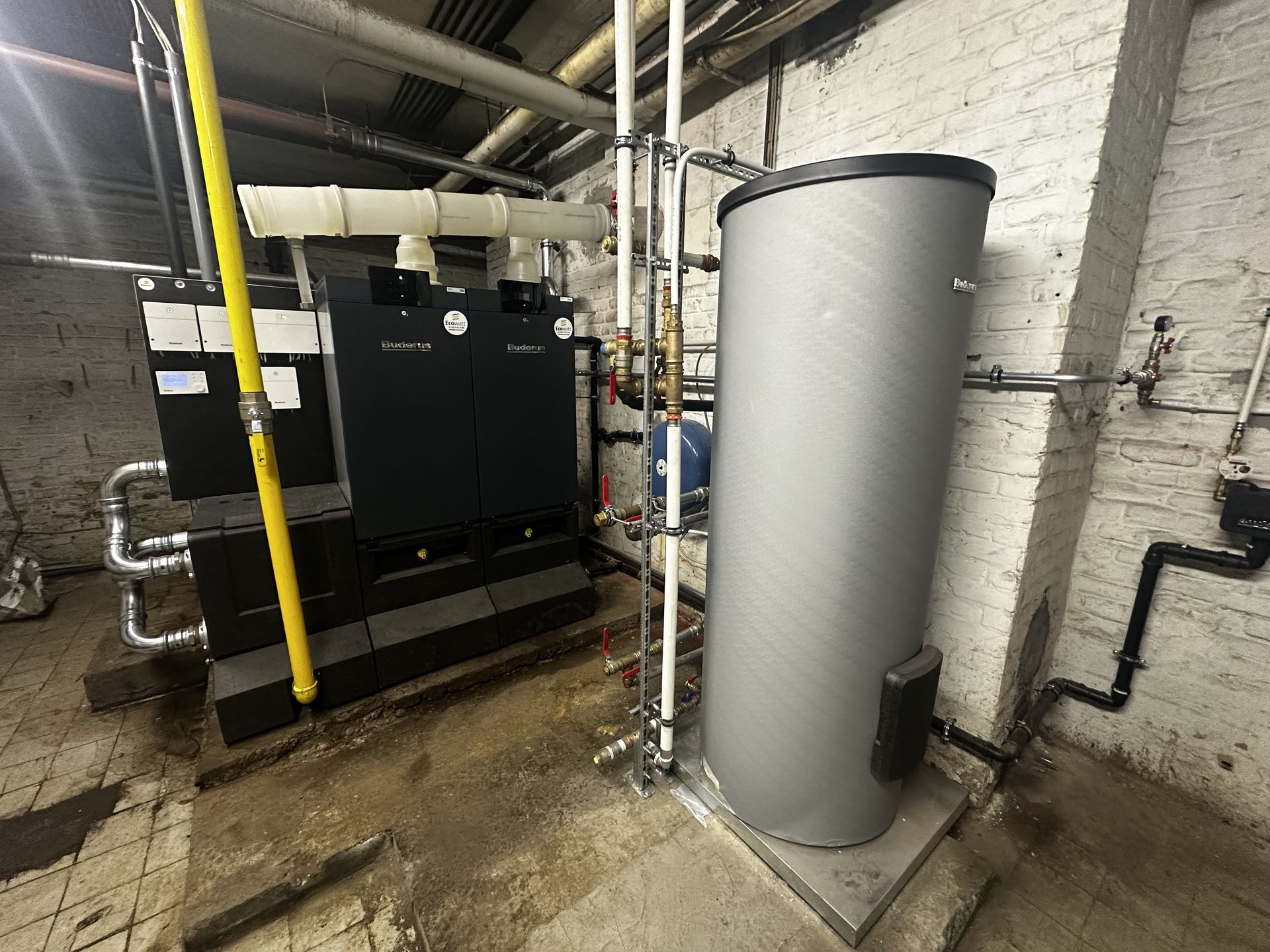
In Brussels, on Avenue Louise, we renovated the collective boiler room of a single building — heated by two separate boilers — replacing two old oil boilers with two gas condensing boilers in cascade.
The context
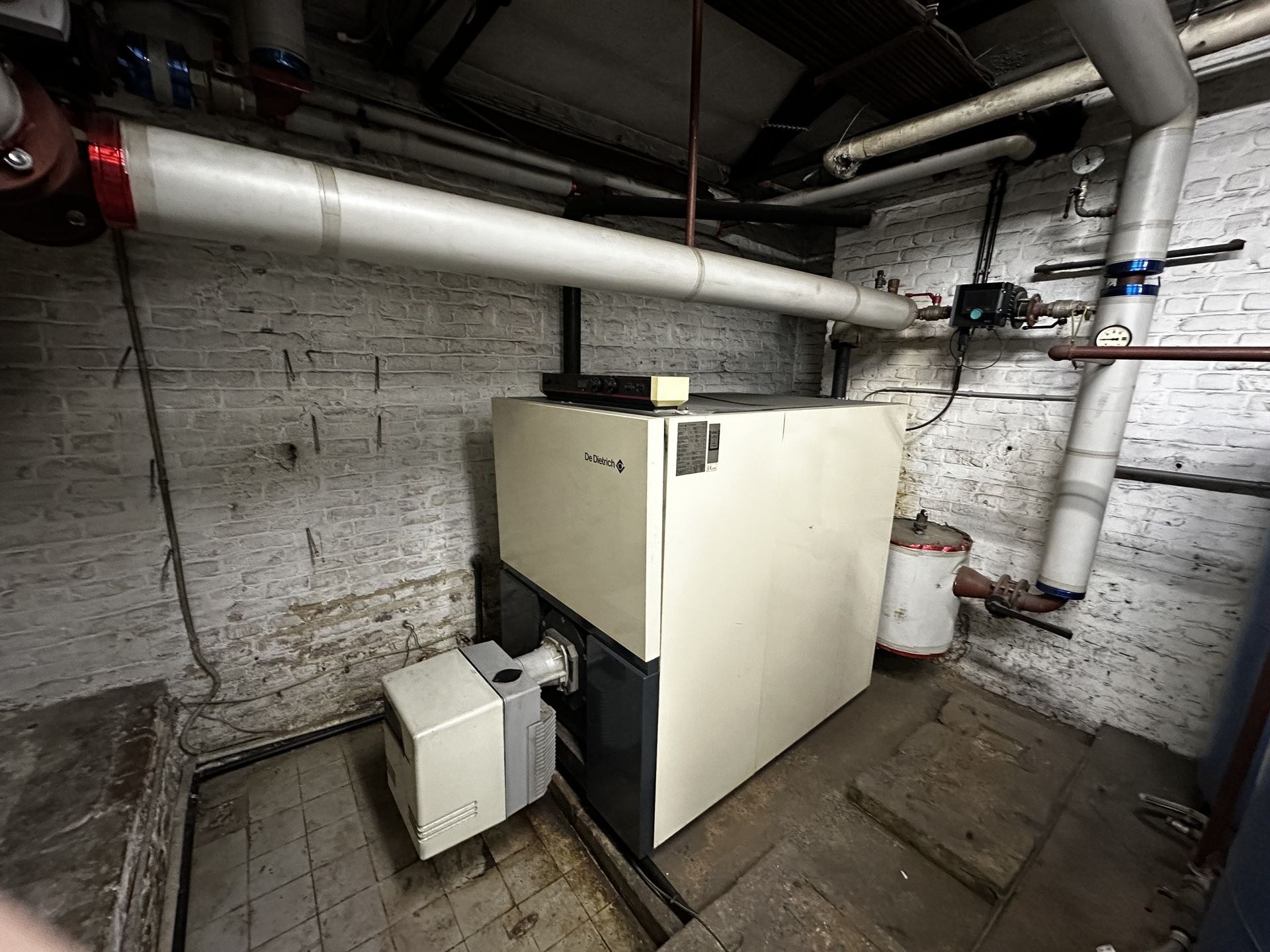
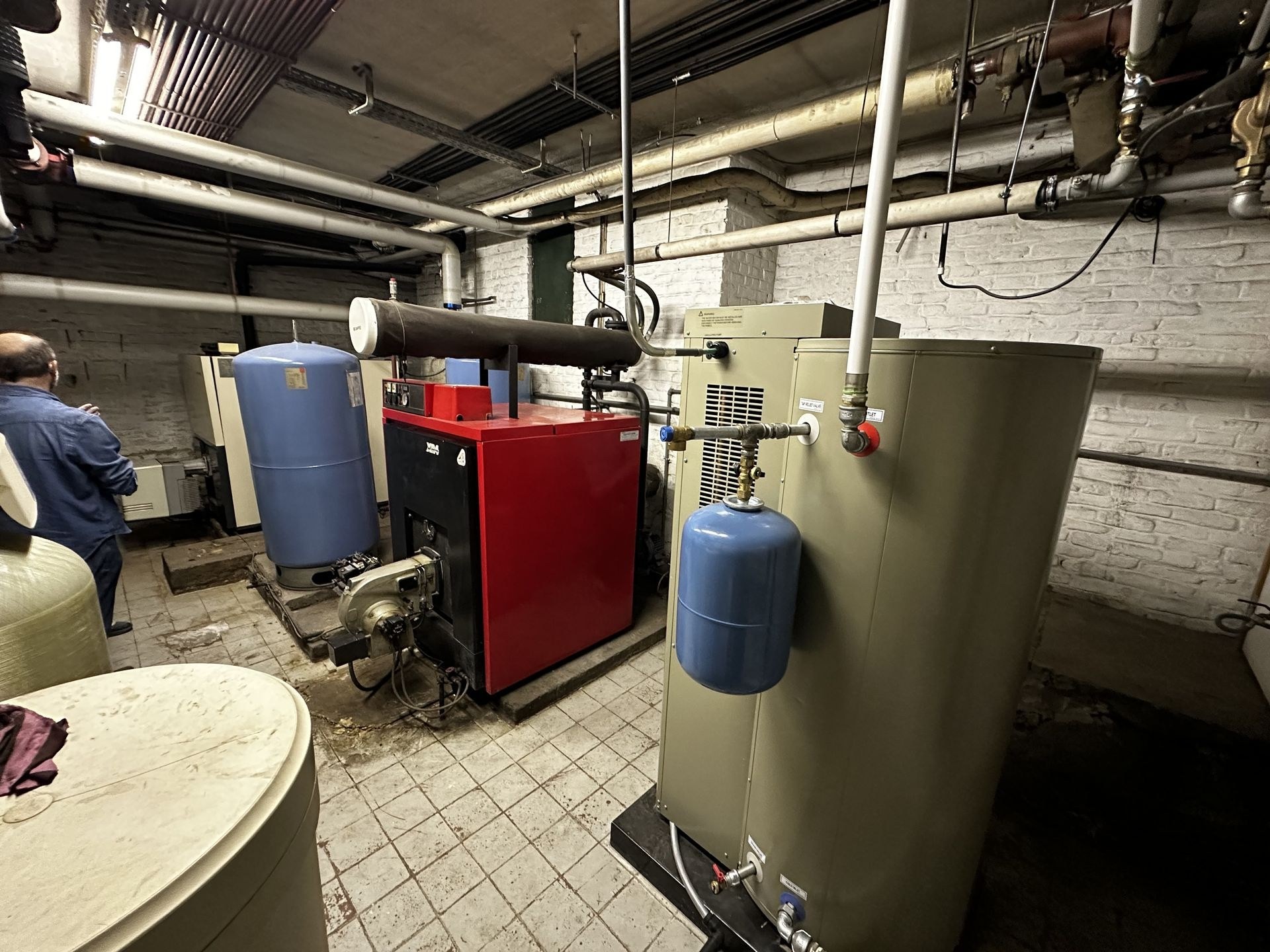
A 1970s building, around 2,000 m² and 18 apartments, heated by an ageing oil boiler room: a 250 kW boiler for heating and a second 226 kW boiler for hot water — nearly 476 kW installed, heavily oversized and energy-hungry.
A decision based on an energy audit
Rather than replacing like-for-like, the choice was based on an independent energy audit. The figures were clear: hot water ran on a 226 kW boiler where about 30 kW is enough, and the heating was oversized by at least 20%. Deciding on real data, not guesswork.
The installed solution
- ✅ Two Buderus Logano plus GB272 gas condensing boilers in cascade (~100 kW each), replacing the two oil boilers.
- ✅ A drastic reduction in installed power: from about 476 kW on oil to ~200 kW on gas — the right output at last.
- ✅ Cascade for continuity: if one boiler stops, the other takes over — no heating or hot-water interruption for the 18 apartments.
- ✅ Moving away from oil (installing new oil boilers is now banned in Brussels) to condensing gas, cleaner and more efficient, with a flue liner.
- ✅ Protecting the installation: sludge and air separators and hydraulic decoupling to protect the new boilers.
- ✅ A substantial installation: two 400 L buffer tanks were needed to feed and balance the building's four heating columns — the scale a building this size demands.
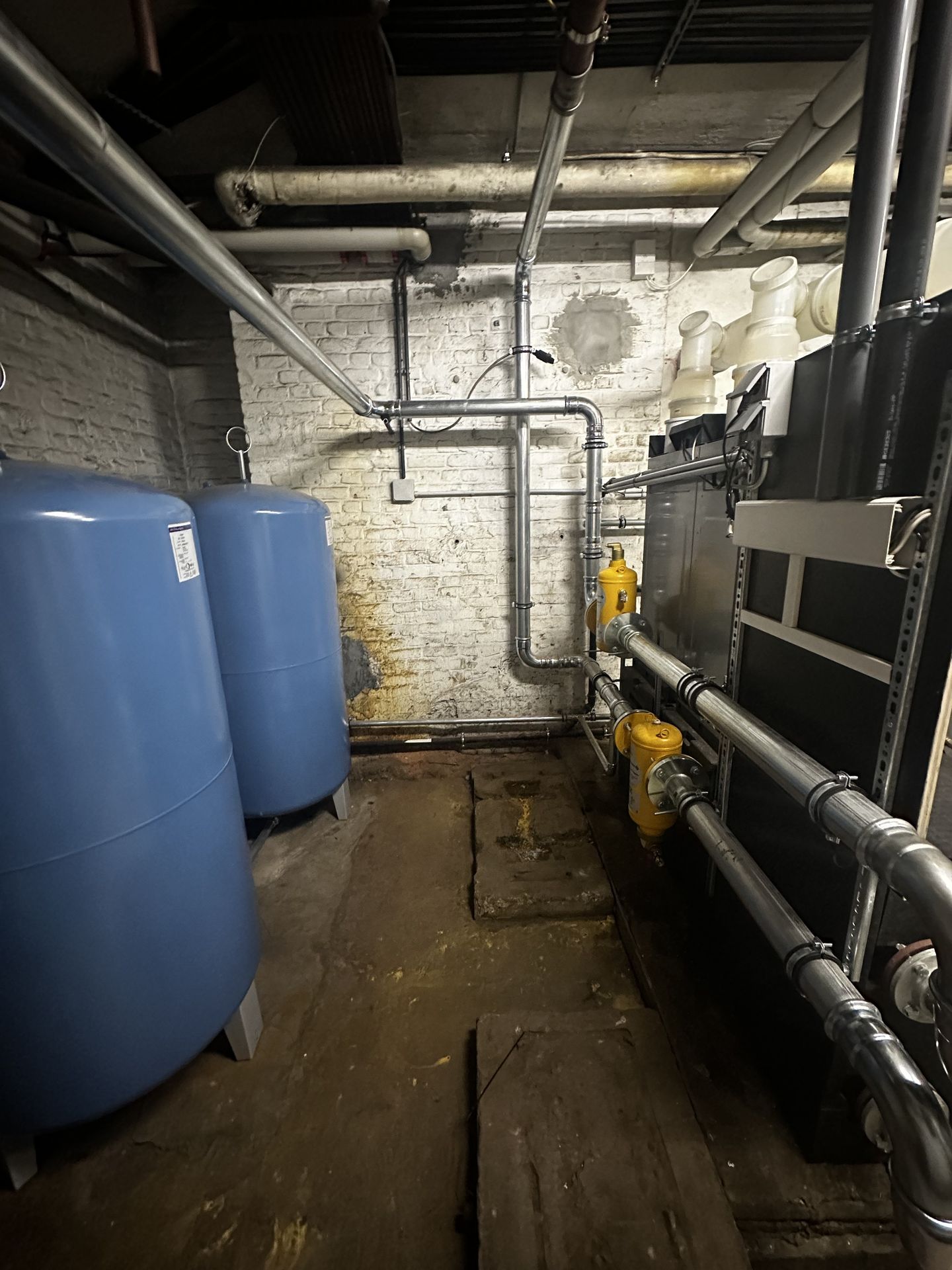
Hot water, done smarter
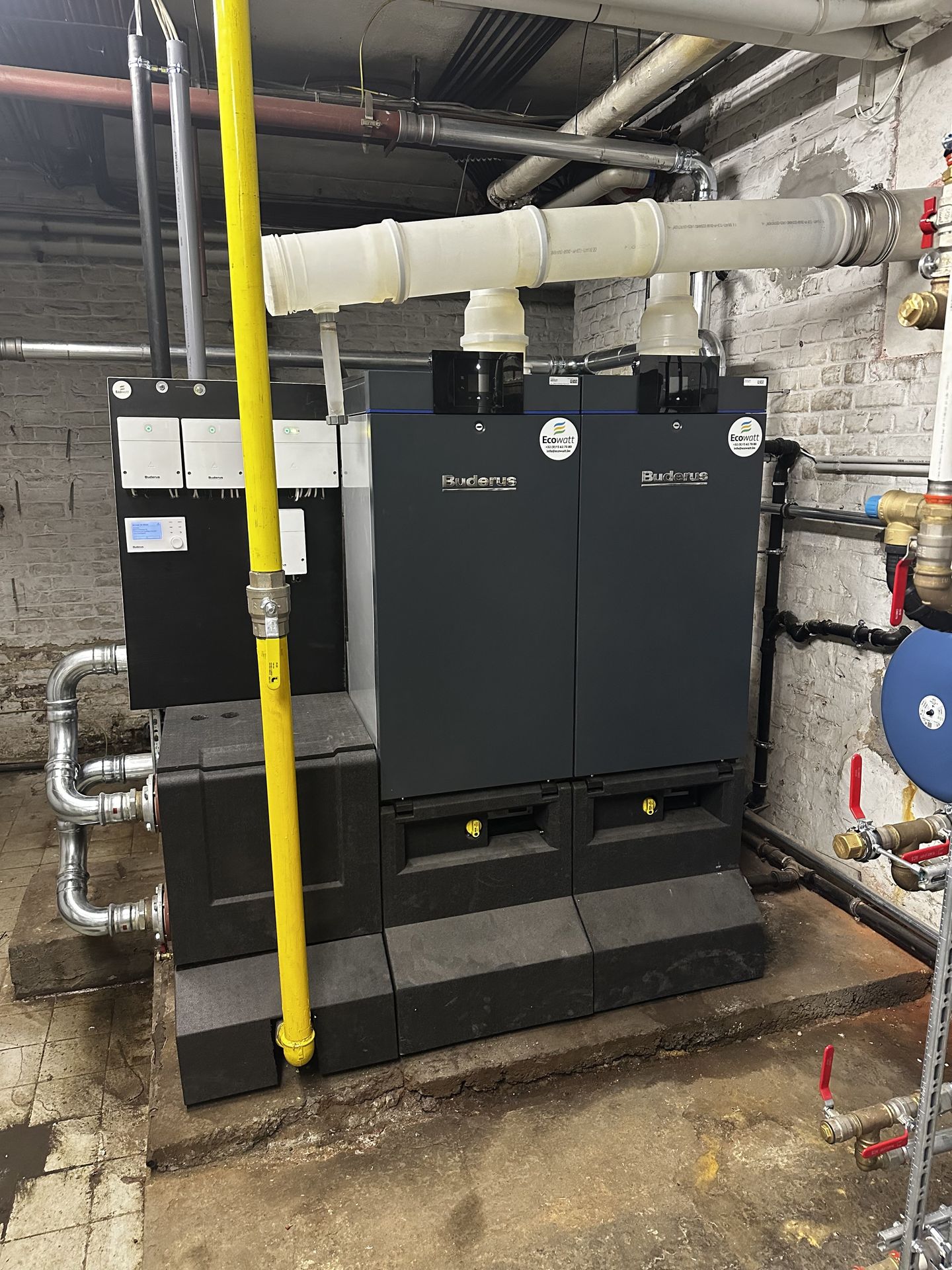
The building already had a thermodynamic water heater, in place before our work — we did not install it. We turned it into the first stage of domestic hot-water production, in series with a new 400 L thermal tank: the water "warmed" by the thermodynamic tank then flows into the 400 L tank, which brings it up to temperature.
This "warming" is not free — but it stacks up real advantages. The thermodynamic tank draws its heat from the air of the boiler room itself: it recovers the heat otherwise lost by the boilers and the pipework, bringing those thermal losses down to virtually zero — energy that would have been wasted, reused to pre-heat the domestic hot water.
We also fitted a set of valves that lets the system run on the thermodynamic tank alone or on the 400 L tank alone. This makes maintenance far simpler and gives more flexibility and comfort — for the technicians and for the residents alike.
A project carried out with Aetra
This project was carried out in collaboration with Aetra. Renovating a collective boiler room takes coordination — study, sizing, careful execution in an occupied building — and that's exactly what we love to do.
 ×
×
A similar project?
Do you manage a co-ownership, a property syndic or a collective building? Our advisors carry out a free assessment for the best boiler-room solution.
Discover our boiler-room solutions for apartment buildings →